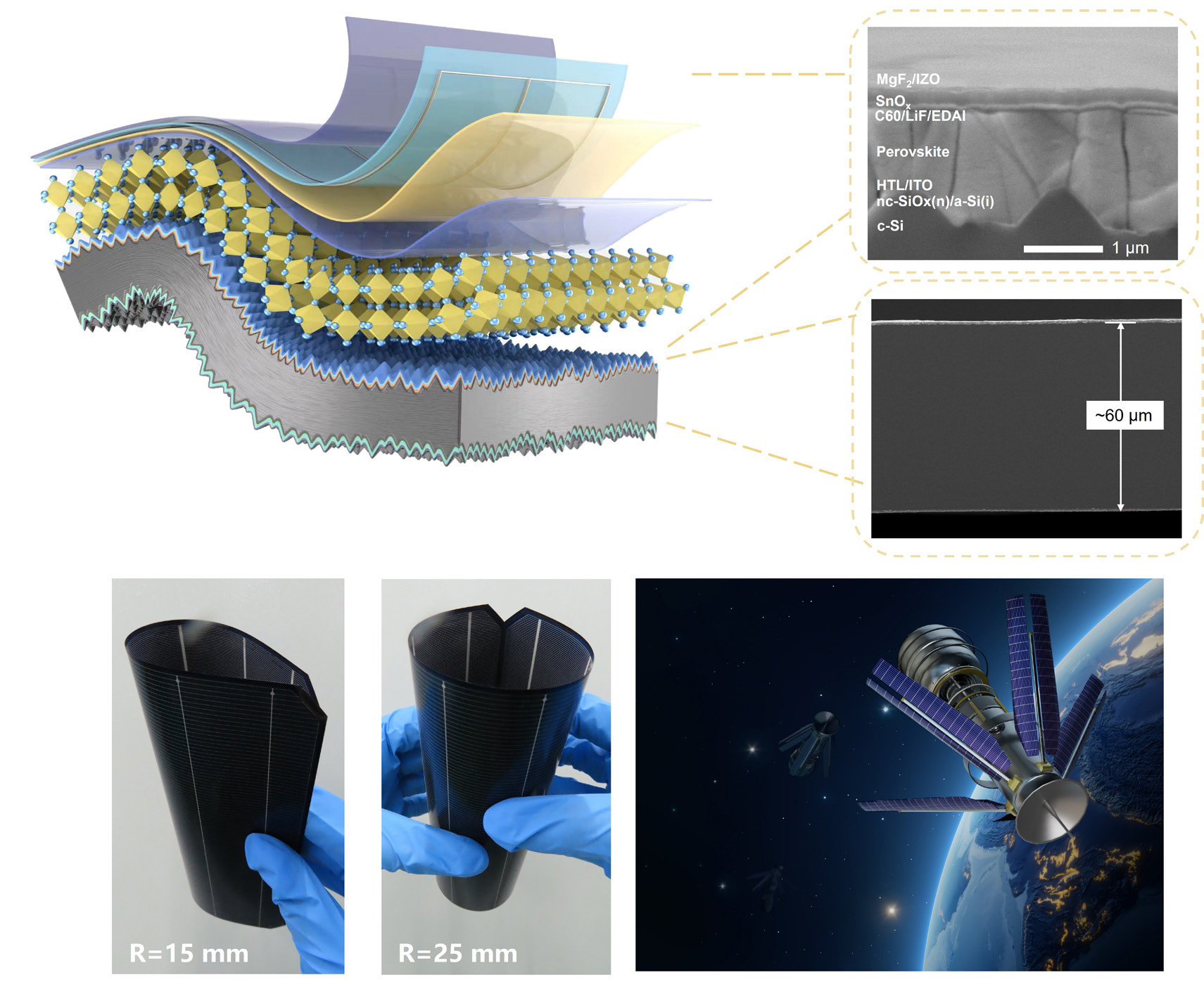
Flexible perovskite/silicon tandem photovoltaic technology, characterized by low cost, high efficiency, light weight, flexibility, and a high power-to-weight ratio, represents a critical direction for next-generation aerospace photovoltaic applications. However, this technology still faces challenges related to interfacial delamination and performance degradation under mechanical stress such as bending or thermal expansion/contraction, which limit device efficiency and stability.
This research has proposed two innovative interfacial regulation strategies based on the principle of opto-electro-mechanical synergistic modulation. First, they constructed a buffer layer with a “loose-tight” bilayer structure, achieving synergistic stress dissipation and efficient charge transport at the nanoscale. This approach yielded an internationally certified efficiency exceeding 33.3% (1 cm2 ) for a small-area flexible tandem cell, while full-wafer-scale devices achieved a certified efficiency of 29.8% (261 cm2 ), demonstrating excellent bending resistance and wide-temperature-range stability. Second, they developed an indium cerium oxide thin film preparation method using reactive plasma deposition, which enhanced self-assembled monolayer coverage and interfacial charge transport efficiency. Through in-situ annealing, they prepared zinc-doped indium oxide front transparent electrodes, which improved both the optoelectronic performance and mechanical properties of the devices. This resulted in flexible solar cells achieving a certified efficiency of 33.6% with an open-circuit voltage of 2.015 V. The devices exhibited excellent stability under repeated bending and damp-heat conditions, maintaining an extrapolated lifetime exceeding 2,000 hours under continuous illumination.
This research opens up new application scenarios for the silicon-based photovoltaic industry and shows significant potential in fields such as aerospace.
Main contributors: ZHANG Xiaohong, LIU Jiang, YANG Xinbo, HE Bo, LI Zhenguo, XU Xixiang, QU Minghao
Main supporting institutions: Soochow University; Longi Green Energy Technology Co., Ltd.