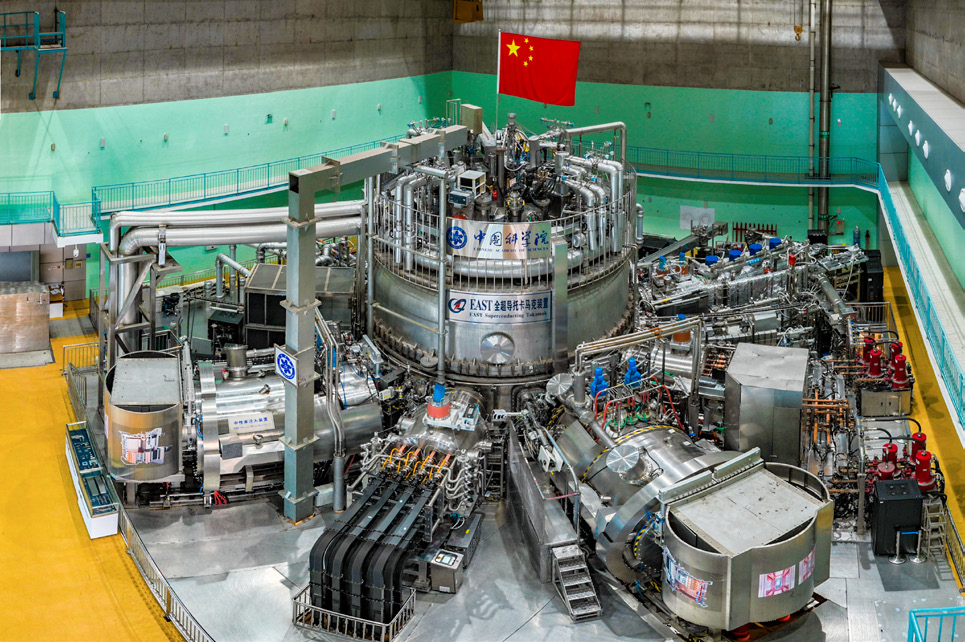
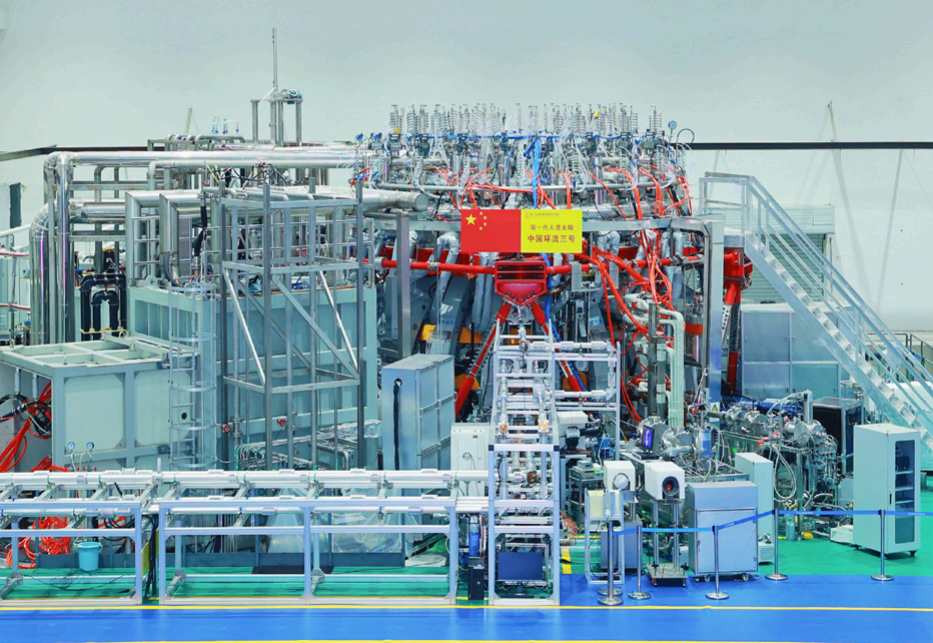
Controlled nuclear fusion, with its advantages of abundant resources, environmental friendliness, and inherent safety, is recognized as one of the crucial pathways to ultimately solving the energy problem for humanity. The Experimental Advanced Superconducting Tokamak (EAST) and the Huanliu-3 nuclear fusion device (HL-3) have both achieved operation at 100 million-degree Celsius regime.
The EAST team has resolved key issues in core-edge integration and plasma-wall interactions, targeting frontier physics of steady-state high-performance tokamak plasmas. Steady-state long-pulse high-mode plasma operation has been achieved at temperatures above 100 million degrees Celsius for a duration of 1,066 seconds, verifying the feasibility of steady-state high-mode plasma operation for fusion reactors. The operation marks humans have firstly replicated experimental conditions required for future fusion reactors, which is of great importance for the development and operation of fusion power plants.
The HL-3 team has overcome key technologies such as high-power microwave gyrotrons and high-power neutral beam heating, to meet the critical threshold conditions required for burning plasma. This progress realized high-parameter operation with an ion temperature of 117 million degrees Celsius and an electron temperature of 160 million degrees Celsius. Furthermore, under sustained high-mode operation with plasma currents exceeding 1 M Ampere and ion temperatures above 100 million degrees Celsius, the fusion triple product has been increased by nearly tenfold to the order of 1020 keV·s·m-3. The research lays the foundation for the burning plasma experiments of controlled nuclear fusion devices.
Main supporting institutions: Hefei Institutes of Physical Science, CAS; Southwestern Institute of Physics, China National Nuclear Corporation