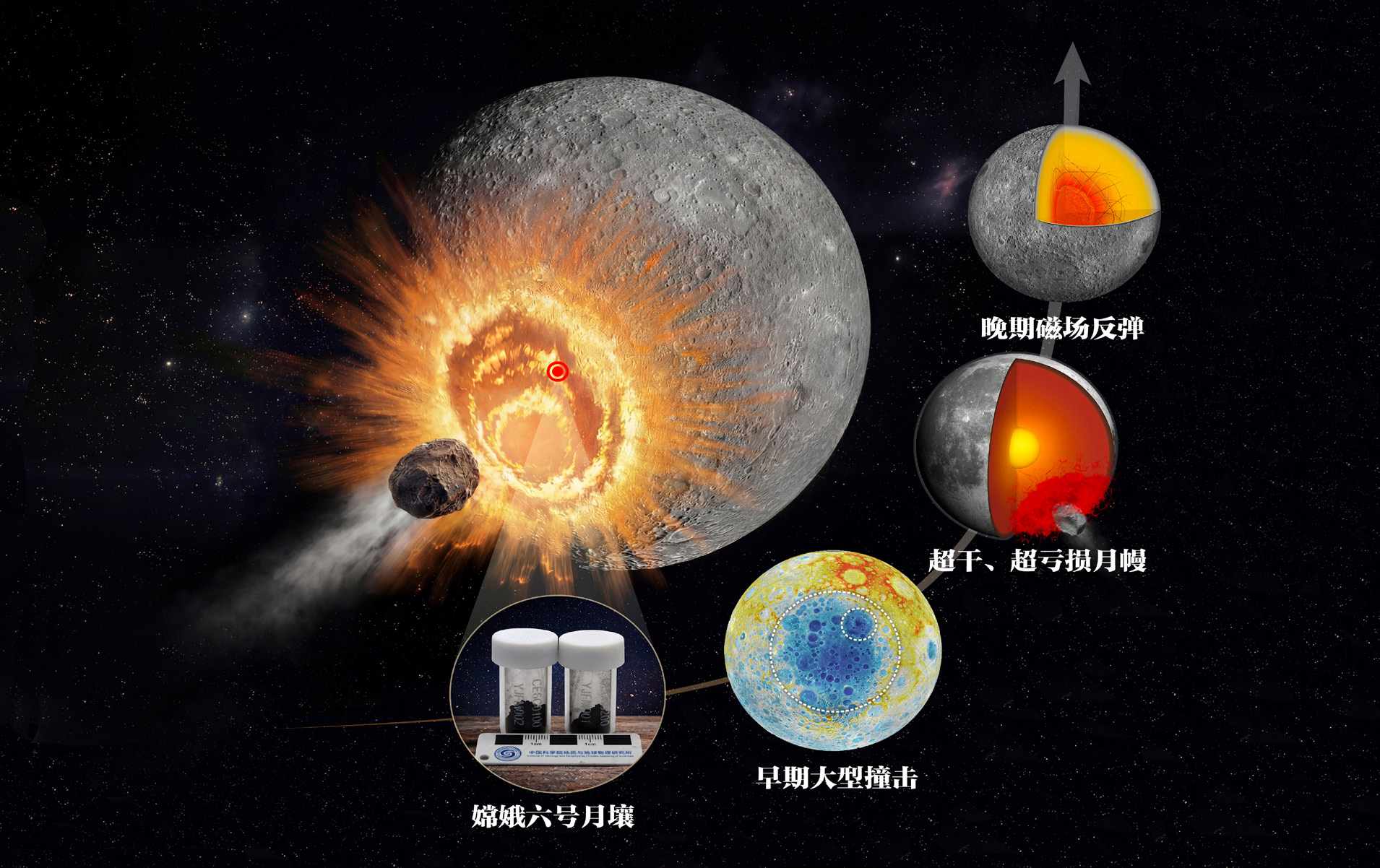
The Chang’e-6 mission has, for the first time, returned lunar soil samples from the South Pole-Aitken (SPA) basin on the Moon’s far side, providing invaluable material to unravel the evolutionary history of the lunar far side.
Through detailed analysis of these samples, this research has achieved multiple original breakthroughs. A new type of impact-derived lunar rock has been identified. Dating on these impact-melt rocks constrains the formation ages of the Moon’s largest impact basin, the SPA basin, and its interior, the Apollo basin, to 4.25 billion years and 4.16 billion years ago, respectively. These constraints provide key chronological markers for understanding the early impact history of the Moon. The research reports the first measurements of water content and chemical composition for the lunar far-side mantle. The new results reveal that the far-side mantle is drier and more isotopically depleted in Sr–Nd than its nearside counterpart, with a U–Pb isotopic ratio that deviates from the near-side mantle’s evolution trend. These findings indicate that the giant impact modified the nature of the lunar mantle beneath the SPA basin. The first paleomagnetic record from the lunar far side has been obtained, discovering a reinforced magnetic field intensity around 2.8 billion years ago. This discovery indicates that the lunar magnetic field did not decay monotonically but experienced fluctuations.
These advances extend the lunar near-side–far-side asymmetry observed in the crust to the deep mantle, refresh our knowledge of the spatial and temporal evolution of the Moon’s paleomagnetic field, reshape our understanding of the early impact history and its effects on the lunar far side, and mark a new phase in lunar science characterized by an integrated understanding of coupled endogenic and exogenic geological processes.
Main contributors: WU Fuyuan, CHEN Yi, XU Yigang, LI Chunlai, LIN Yangting, HU Sen, YANG Wei, CAI Shuhui, CHE Xiaochao, LONG Tao, HUI Hejiu
Main supporting institutions: Institute of Geology and Geophysics, CAS; Guangzhou Institute of Geochemistry, CAS; National Astronomical Observatories, CAS; Institute of Geology, Chinese Academy of Geological Sciences; Nanjing University